Imagine you have ₹20,000 to spend every month on marketing.
You have two choices.
You can invest that money into SEO, AEO and GEO and wait for organic visibility to build.
Or you can put the money into PPC, social media advertising and other paid campaigns and start getting traffic much faster.
For many businesses, the second option feels more attractive.
Why?
Because the results are visible quickly.
You launch an ad.
People see it.
Some click.
Some enquire.
You can see the numbers almost immediately.
SEO feels different.
You may spend months improving pages, publishing content, building topical authority and fixing technical issues before seeing significant results.
This is why many clients say:
“Why should I wait 6-8 months for SEO when I can run ads today?”
It is a fair question.
But there is another question businesses should ask:
“What happens after those six months?”
The difference is not speed. It is what you build.
PPC and SEO solve different marketing problems.
Paid advertising is designed to buy visibility.
SEO is designed to build organic visibility.
With Google Ads using CPC bidding, advertisers pay when someone clicks the advertisement. Google also allows advertisers to set budgets for campaigns.
That makes PPC extremely useful when a business needs immediate traffic.
But the traffic is connected to an active advertising campaign.
If you stop funding the campaign, you should not expect the same volume of paid clicks to continue.
Google itself explains that changing or reducing an advertising budget can affect how frequently ads are shown and how many clicks and conversions they generate.
SEO works differently.
You invest in improving the website and its content.
If a page eventually earns strong organic visibility, it can continue receiving organic impressions and clicks without paying Google for every click.
But there is an important qualification:
SEO is not “pay once and rank forever.”
Rankings can change.
Competitors publish better content.
Search algorithms evolve.
Search intent changes.
Your content becomes outdated.
Therefore, SEO should be viewed as an asset that needs maintenance, not as a one-time payment that guarantees permanent rankings.
What does 6 months of PPC look like?
Let’s take a simple example.
Suppose a business spends:
₹50,000 per month on PPC.
Over six months:
₹50,000 × 6 = ₹3,00,000
During those six months, the campaign may generate clicks, leads and sales depending on the market, targeting, landing page and conversion rate.
That’s the advantage of PPC.
You can start testing demand relatively quickly.
But imagine the company stops the campaign after month six.
The advertising budget becomes zero.
The paid campaign stops buying clicks.
The business can still have customers from previous campaigns, brand awareness and other benefits, but it should not assume that the same paid traffic will continue without ongoing spend.
This is why PPC is often better understood as an ongoing traffic acquisition channel.
What does 6 months of SEO look like?
Now imagine the same business invests ₹50,000 per month into SEO.
The first few months may involve:
- Technical SEO
- Keyword research
- Search-intent analysis
- Existing content optimisation
- New landing pages
- Internal linking
- Topical authority
- Competitor analysis
- AEO content
- GEO/AI-search optimisation
The early results may look disappointing compared with PPC.
You might see:
Month 1: improvements in technical health
Month 2: pages being indexed and optimised
Month 3: keyword movement
Month 4: more impressions
Month 5: stronger rankings for some queries
Month 6: increasing organic visibility
This isn’t a guaranteed timeline. Some websites can see movement much earlier, while competitive websites may take considerably longer.
The important point is that SEO work creates something on the website.
The optimisation remains.
The content remains.
The internal links remain.
The technical improvements remain.
And the organic rankings can continue producing traffic after the original work is completed.
This is where businesses often compare SEO and PPC incorrectly
A common comparison is:
“PPC gave me leads in the first month. SEO didn’t.”
That’s true.
But it isn’t an apples-to-apples comparison.
PPC is designed to produce paid visibility quickly.
SEO generally requires time to build organic visibility.
A better comparison is:
“What did I build after six months?”
With PPC, you purchased traffic during the campaign.
With SEO, you attempted to build organic search visibility that can continue producing value beyond individual ad clicks.
Neither is automatically better.
The right choice depends on the business.
Why do businesses still choose PPC?
Because waiting is difficult.
A business has monthly targets.
Sales teams need leads.
New businesses need customers.
An ecommerce company may need immediate traffic.
A seasonal business may not have six months to wait.
In these situations, paid advertising can be extremely useful.
Google even provides budget and performance planning tools to help advertisers estimate how budget changes may affect traffic and conversions.
The mistake isn’t running PPC.
The mistake is assuming PPC has to replace SEO.
The smarter strategy can be SEO + PPC
For many businesses, the strongest approach is not:
SEO vs PPC.
It is:
SEO + PPC.
PPC can generate immediate demand while SEO builds long-term organic visibility.
For example:
PPC can target high-converting commercial keywords immediately.
SEO can work on the same topics organically.
The paid campaign can provide data about which keywords and messages convert.
That information can help inform organic content strategy.
Over time, successful organic rankings may reduce the business’s dependence on paid traffic for some searches.
Where do AEO and GEO fit?
Search is changing.
People aren’t only typing traditional keywords into Google anymore.
They are asking complete questions and using AI-powered search experiences to research products, services and businesses.
That’s where AEO and GEO become relevant.
AEO focuses on making content useful for answer-based searches.
GEO focuses on improving the chances that a brand’s information can be understood and surfaced in generative search experiences.
But AEO/GEO shouldn’t be treated as a completely separate replacement for SEO.
Strong technical foundations, useful content, clear information and good website structure remain important.
A focused 10-12 keyword SEO strategy can also incorporate AEO and GEO without treating them as completely separate campaigns.
Google’s guidance for AI search features also points website owners toward established SEO fundamentals and helpful, people-first content rather than a separate “AI ranking trick.”
The biggest misunderstanding about SEO
Many businesses think:
“SEO takes 6 months, so nothing happens for 6 months.”
That’s not necessarily true.
SEO is measurable throughout the process.
You can track:
- Impressions
- Clicks
- Keyword positions
- Indexed pages
- Organic traffic
- Search visibility
- Engagement
- Leads
- Conversions
A keyword moving from position 45 to position 18 is progress.
A page moving from page 3 to page 1 is progress.
Organic impressions increasing by 100% is progress.
More relevant queries generating impressions is progress.
The final business outcome matters, but SEO progress shouldn’t be judged only by whether a keyword reached position #1.
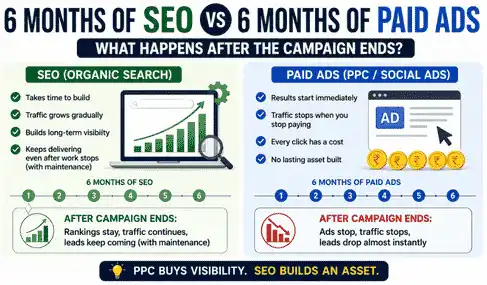
What happens after the campaign ends?
This is the question every business should ask before choosing a marketing channel.
If PPC stops:
Paid visibility generally stops because the business is no longer purchasing those ad placements.
If SEO work stops:
The website doesn’t disappear.
The content remains.
The technical improvements remain.
The backlinks that were legitimately earned remain.
The organic rankings may continue.
But maintenance still matters.
Competitors continue working.
Google continues evolving.
Content can become outdated.
So a business may need ongoing SEO maintenance even after achieving strong rankings.
That’s very different from saying SEO requires the same level of investment forever.
The long-term economics can look very different
Consider this simplified example:
PPC:
₹50,000/month × 12 months = ₹6,00,000
The business continues paying for the advertising campaign to maintain paid traffic.
SEO:
₹50,000/month × 12 months = ₹6,00,000
The investment goes into the website’s organic visibility.
If the SEO campaign successfully builds rankings, those pages may continue generating organic traffic after the initial 12-month period.
That doesn’t mean the traffic is “free.”
There are ongoing costs for content updates, technical maintenance, strategy and other SEO activities.
But you are no longer paying a media platform for every organic click.
That difference is the real reason businesses should think about SEO as a long-term asset.
So, should you stop PPC?
No.
PPC can be excellent when you need:
- Immediate leads
- Immediate traffic
- Product launches
- Seasonal campaigns
- Local promotions
- Short-term offers
- Testing new markets
The better question is whether your entire marketing strategy depends on paid traffic.
If 100% of your traffic disappears when your advertising budget stops, that’s a risk worth considering.
What should businesses do instead?
A balanced strategy could look like this:
Short term:
Use PPC to capture existing demand and generate immediate leads.
Medium term:
Invest in SEO to improve organic rankings for commercial searches.
Long term:
Build topical authority, content assets, brand visibility and AEO/GEO presence.
This creates multiple sources of visibility instead of depending on one channel.
The real question isn’t “SEO or PPC?”
The real question is:
“Do I want to keep buying traffic, or do I also want to build an organic traffic asset?”
PPC can be the faster option.
SEO can be the slower build.
AEO/GEO can extend your visibility into changing search and AI-driven discovery.
For many businesses, the strongest marketing strategy is to use paid campaigns for immediate demand while building organic visibility for long-term growth.
Because six months later, the difference isn’t simply how much traffic you received.
It’s what you still have when the campaign budget stops.
And that’s where SEO can become strategically valuable.
Conclusion
Don’t reject SEO simply because it takes time.
Don’t choose PPC simply because it is fast.
Understand what each channel is actually buying for your business.
PPC buys immediate advertising visibility.
SEO builds organic search visibility.
AEO/GEO helps prepare your content and brand for answer-driven and generative search.
The smartest strategy is often not choosing one over another, but using each channel for the job it does best.