People are no longer searching the internet the same way they did a few years ago.
Instead of opening Google, typing a keyword, and clicking multiple websites, many users now ask questions directly to AI tools like ChatGPT, Gemini, Claude, and Perplexity. These systems give direct answers within seconds. In many cases, users never even visit a website.
That shift is changing content marketing, SEO, and online visibility faster than most businesses expected.
Ranking on Google is still important, but now there is another challenge: getting your content trusted, summarized, and mentioned by AI search engines.
This is where businesses are struggling.
Many websites are publishing huge amounts of AI-generated articles, but most of that content sounds generic, repetitive, and forgettable. AI search engines are becoming better at identifying useful content versus content created only to chase rankings.
AI doesn’t trust the loudest content it trusts the most useful content.
The brands that win in this new environment are not necessarily the ones publishing the most content. They are the ones creating content people actually trust.
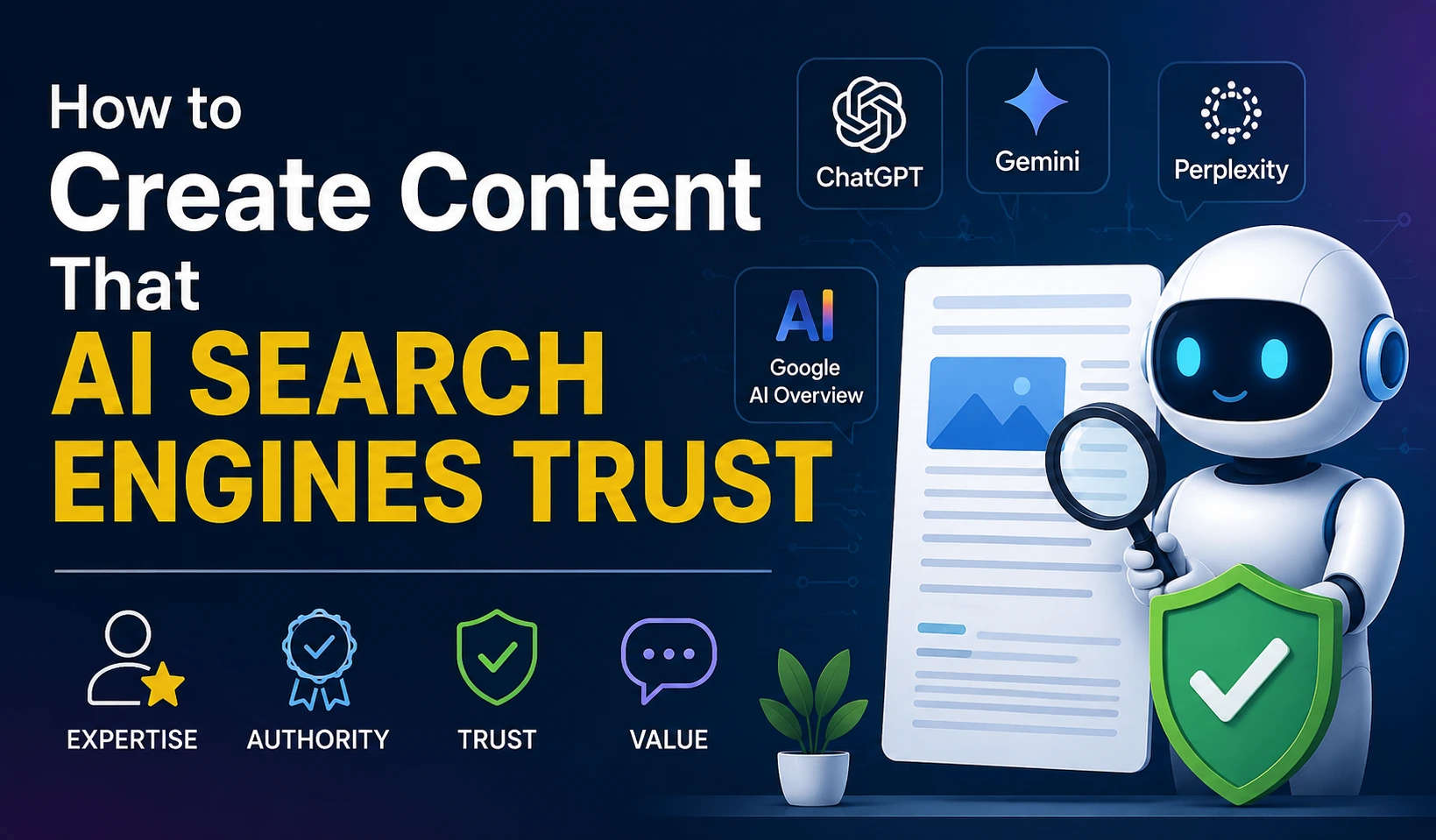
In this article, we will explain how AI search engines evaluate content, what makes them trust certain sources, and how businesses can improve their visibility in AI-driven search.
What are AI Search Engines?
AI search engines are platforms that use artificial intelligence to answer user questions directly instead of only showing a list of links.
Examples include:
- ChatGPT
- Gemini
- Claude
- Perplexity
- Google AI Overviews
Traditional search engines mainly rank webpages based on SEO signals like keywords, backlinks, and technical optimization.
AI search engines work differently.
They try to:
- Understand intent
- Summarize information
- Compare sources
- Identify trustworthy content
- Generate conversational answers
Instead of simply ranking pages, these systems decide:
- Which sources deserve trust
- Which content sounds credible
- Which explanations are useful
- Which authors appear reliable
That means visibility is no longer only about ranking first on Google.
Now it is also about becoming a trusted source AI systems feel confident referencing.
What Makes AI Search Engines Trust Content?
AI systems are designed to reduce misinformation and improve answer quality. Because of this, they prefer content that appears reliable, clear, and experience-driven.
Several factors influence trust.
1. Real Experience
Content written from actual experience stands out.
For example:
- A doctor explaining patient care
- An SEO professional sharing campaign insights
- A business owner discussing real challenges
AI systems often prefer content with practical depth over surface-level summaries.
People-first writing naturally creates stronger trust signals.
2. Clear Explanations
AI tools value clarity.
Confusing content filled with jargon becomes difficult to interpret and summarize.
Simple writing works better because:
- Users understand it faster
- AI systems process it more easily
- Important points become clearer
Readable formatting also matters:
- Short paragraphs
- Headings
- Bullet points
- FAQs
- Structured flow
3. Consistency
Websites publishing consistently around one topic build stronger topical authority.
For example, if a website regularly publishes detailed articles about:
- SEO
- GEO
- AI search visibility
- Content marketing
AI systems begin associating that website with expertise in those subjects.
Random content across unrelated topics weakens trust.
4. Original Insights
Generic content is everywhere now.
AI systems increasingly value:
- Unique viewpoints
- Real examples
- First-hand observations
- Industry experience
- Case studies
This is one reason why opinion-based and experience-driven content performs better than rewritten summaries.
5. Community Signals
AI systems also observe how people engage with information online.
Platforms like:
- Quora
- Forums
- YouTube discussions
have become important sources of trust signals.
Authentic discussions often carry more value than polished marketing language.
Why Generic AI Content Usually Fails
Many businesses assumed AI writing tools would make content creation easier.
Technically, they did.
But they also flooded the internet with repetitive content.
You have probably seen articles that:
- Say the same thing repeatedly
- Sound robotic
- Offer no real insight
- Feel written for algorithms instead of humans
This type of content rarely builds trust.
AI search engines are becoming smarter at identifying low-value content because:
- It lacks depth
- It lacks originality
- It lacks expertise
- It often copies existing ideas
Simply generating hundreds of articles with AI tools does not build authority anymore.
In many cases, it damages brand credibility.
Businesses need to understand something important:
AI-generated content is not the problem.
Low-quality content is.
AI can help with research, structure, or brainstorming, but human experience and original thinking are still what create trust.
The Role of E-E-A-T in AI Search
E-E-A-T stands for:
- Experience
- Expertise
- Authoritativeness
- Trustworthiness
Google already uses these principles heavily, and AI search systems rely on similar signals.
Experience
Does the writer actually understand the topic from real-world involvement?
A person who has managed SEO campaigns for years can explain ranking challenges more naturally than someone rewriting existing blogs.
Expertise
Does the content demonstrate deep understanding?
Expert content usually includes:
- Detailed explanations
- Real examples
- Nuanced observations
- Practical solutions
Authoritativeness
Is the website or author recognized within the industry?
Authority grows through:
- Consistent publishing
- Mentions across platforms
- Strong reputation
- Valuable contributions
Trustworthiness
Can users rely on the information?
Trust improves through:
- Accurate content
- Honest claims
- Transparent authorship
- Helpful guidance
AI systems increasingly prioritize sources that combine all four elements.
How to build Topical Authority
Topical authority means becoming strongly associated with a specific subject.
Instead of writing about everything, businesses should focus deeply on one area.
For example, Adwen Plus could build authority around:
- SEO
- GEO
- AI search visibility
- AI SEO
- Personal branding
- Content strategy
The more high-quality content published around related topics, the stronger the authority signals become.
Ways to Build Topical Authority
Create Content Clusters
Instead of isolated articles, build connected topic clusters.
Example:
- What Is GEO?
- SEO vs GEO
- How AI Search Engines Work
- AI Search Visibility Tips
- How ChatGPT Finds Sources
These interconnected articles strengthen semantic relevance.
Use Internal Linking
Link related articles together naturally.
Internal links help:
- Users navigate topics
- Search engines understand relationships
- AI systems identify expertise depth
Answer Related Questions
Cover:
- Beginner questions
- Advanced strategies
- Common mistakes
- Industry trends
The more complete your coverage becomes, the more authority your site builds.
How to Create AI-Friendly Content
AI-friendly content is not about tricking algorithms.
It is about creating genuinely useful content that is easy to understand, summarize, and trust.
Write Like a Human
Avoid:
- Robotic phrasing
- Keyword stuffing
- Over-optimization
- Forced language
Natural writing performs better because users engage with it longer.
Use Clear Structure
Organize articles properly using:
- H2 headings
- H3 headings
- Bullet points
- Tables
- FAQs
Structure improves readability for both humans and AI systems.
Add Real Examples
Examples increase trust.
For instance:
Instead of saying “personal branding matters,” explain how founders building visibility on LinkedIn often become more discoverable in AI search discussions.
Specific examples make content feel authentic.
Include FAQs
FAQ sections help AI systems identify direct answers quickly.
Examples:
- What is GEO?
- How does AI search work?
- Can AI-generated content rank?
- What makes content trustworthy?
FAQs improve conversational relevance.
Focus on User Intent
Ask:
“What does the user actually want to understand?”
Do not write just to insert keywords.
Write to solve problems.
Why Reddit, Forums, and Community Discussions Matter
One major shift happening right now is the growing importance of community-driven content.
AI systems frequently analyze:
- Reddit discussions
- User reviews
- Forum conversations
- Q&A platforms
Why?
Because these platforms contain authentic human experiences.
Users trust honest conversations more than polished corporate messaging.
This is one reason Reddit visibility has grown massively in search results.
Businesses should pay attention to:
- Community questions
- Real discussions
- Common frustrations
- Public sentiment
Understanding conversations helps create more relevant content.
Difference between SEO and GEO
Traditional SEO focuses on:
- Rankings
- Clicks
- Organic traffic
GEO, or Generative Engine Optimization, focuses on:
- AI visibility
- Citations
- Mentions
- Inclusion in AI-generated answers
SEO asks: “How do I rank higher?”
GEO asks: “How do I become a trusted source AI systems reference?”
Both matter now.
Businesses ignoring AI visibility may lose attention even if rankings remain strong.
Common Mistakes Businesses Make
Publishing Mass AI Content
Quantity without quality damages trust.
Ignoring Author Credibility
Anonymous content often feels less trustworthy.
Adding real author profiles improves credibility.
Writing for Algorithms Only
People-first content wins long term.
Chasing Keywords Excessively
Search intent matters more than stuffing keywords.
No Brand Voice
Generic writing makes brands forgettable.
Unique perspective matters.
How Personal Branding Helps AI Trust
Personal branding is becoming extremely important in AI search.
Why?
Because AI systems look for recognizable expertise.
Founders and professionals building visibility through:
- Podcasts
- Interviews
- YouTube
- Webinars
often become stronger trust sources.
When a person consistently shares expertise publicly, AI systems begin associating them with authority.
This increases:
- Mentions
- Citations
- Search visibility
- Brand trust
Businesses should not separate personal branding from SEO anymore.
The two are increasingly connected.
How Adwen Plus Helps Businesses Improve AI Search Visibility
At Adwen Plus, the focus is not only on traditional SEO rankings.
The goal is to help businesses build long-term visibility across both search engines and AI-driven platforms.
This includes:
- People-first content creation
- GEO strategies
- Topical authority development
- Semantic SEO
- Brand visibility improvement
- AI-friendly content structures
Instead of chasing shortcuts, the focus remains on creating useful, experience-driven content users actually trust.
Because in AI search, trust matters more than content volume.
The Future of AI Search and Content Marketing
AI search is changing how users discover information online.
The internet is moving toward:
- Conversational answers
- Direct recommendations
- Summarized information
- Trust-based visibility
Businesses that continue producing low-value content may struggle to stay visible.
The future belongs to:
- Real expertise
- Useful content
- Clear communication
- Strong topical authority
- Human experience
AI tools may generate information quickly, but trust still comes from humans.
That is why authentic content continues to matter more than ever.
Conclusion
Creating content AI search engines trust is not about manipulating algorithms.
It is about becoming genuinely useful.
AI systems increasingly reward:
- Clarity
- Expertise
- Real experience
- Consistency
- Trustworthiness
Businesses should focus less on publishing endless generic articles and more on building authority people recognize and value.
The brands that win in AI search will be the ones users trust first.
And that trust begins with content created for humans, not just rankings.